
WNBA’s Most Underrated Players in 2026
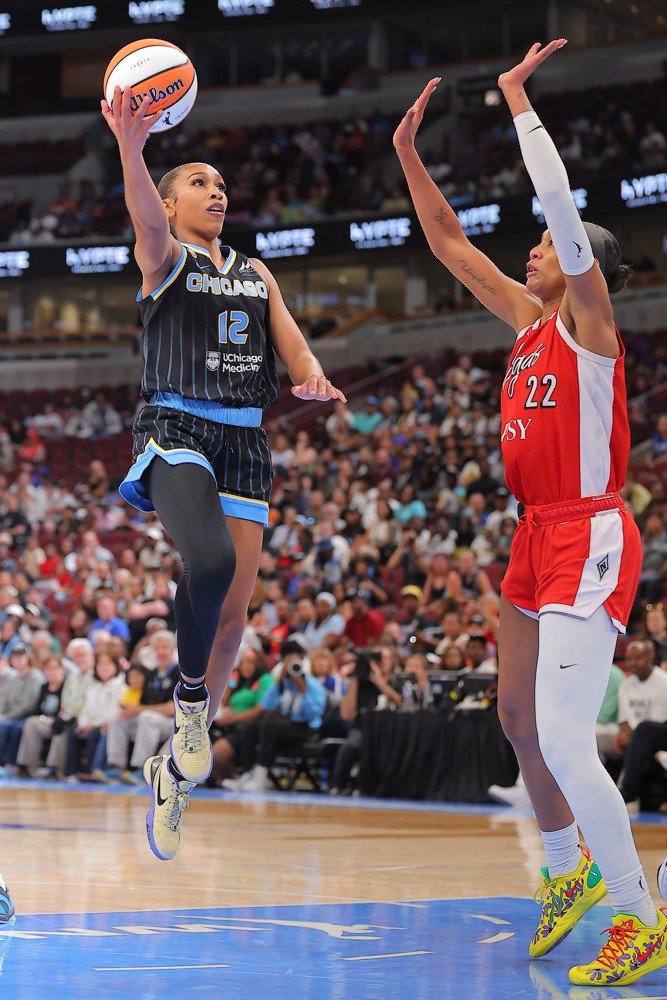
Sydney Taylor leads the pack when it comes to on-court impact relative to popularity. | Photo by Melissa Tamez/Icon Sportswire
The WNBA is experiencing a renaissance, and the league has never been more talented and more fun to watch. But the surge of fandom this brings also heaps new mountains of hot takes, of opinions rooted in confirmation bias, recency bias, home team bias. And with the WNBA All-Star fan votes fully tallied, there is no better time to spotlight which players have flown the most under-the-radar with fans relative to their on-court impact.
What’s the most effective way to determine an impactful player in terms of their ability to contribute to a winning team? Is it filling up the box score? Having the best plus-minus? Bottom-up metrics from traditional box scores solely focus on the result and not the context (e.g. a block counting but perfectly timed help forcing a turnover not counting). Meanwhile, top-down metrics like plus-minus only paint team outcomes, independent of individual contribution, which can boost players on good teams, even if they’re just doing cardio on a nightly basis.
No single metric paints a sufficiently clear picture, but for the sake of simplicity and this thought exercise, a metric that combines top-down and bottom-up measurements into one is a happy medium and a straightforward approach to determine which players have been the most impactful during their time on the court this season.
While there have been a bevy of all-in-one (AIO) metrics created that combine top-down and bottom-up metrics like, BPM/VORP, RPM, EPM, etc.—many of these are consistently officially tracked only for the NBA. The most common all-in-one stat with top-down and bottom-up components tracked and calculated in the WNBA is win shares, and this metric undervalues player gravity, off-ball defense, and positive/winning plays unrecorded by traditional counting stats.
Enter ESPN’s Net Points, which progresses from box score counting to play-by-play data that assigns credit and blame proportionally on team outcomes—capturing previously untracked things such as transition opportunities, matchups, help defense, and shot creation outside of assists—all while pinning it to the team’s overall net rating.
So while the methodology and calculations aren’t fully revealed, this means that in theory, Net Points takes the most comprehensive approach to measuring a player’s impact in the WNBA in an AIO stat today. Thus, it suffices as an indicator for positive impact. Yet Net Points isn’t perfect. Like other AIO stats, it’s weighted somewhat subjectively, and because Net Points is connected to on-court net rating, players on good teams will likely be elevated over equivalent players on bad teams. But if the goal is to find which players have been the steadiest contributors towards winning—the point of a basketball player many would argue—this lean is not unwelcome.
Who then has been the most impactful? Here is the ranking of the top 40 players in the WNBA by Net Points per 80 Possessions* (about the average for a WNBA game) as of 07.01.26.
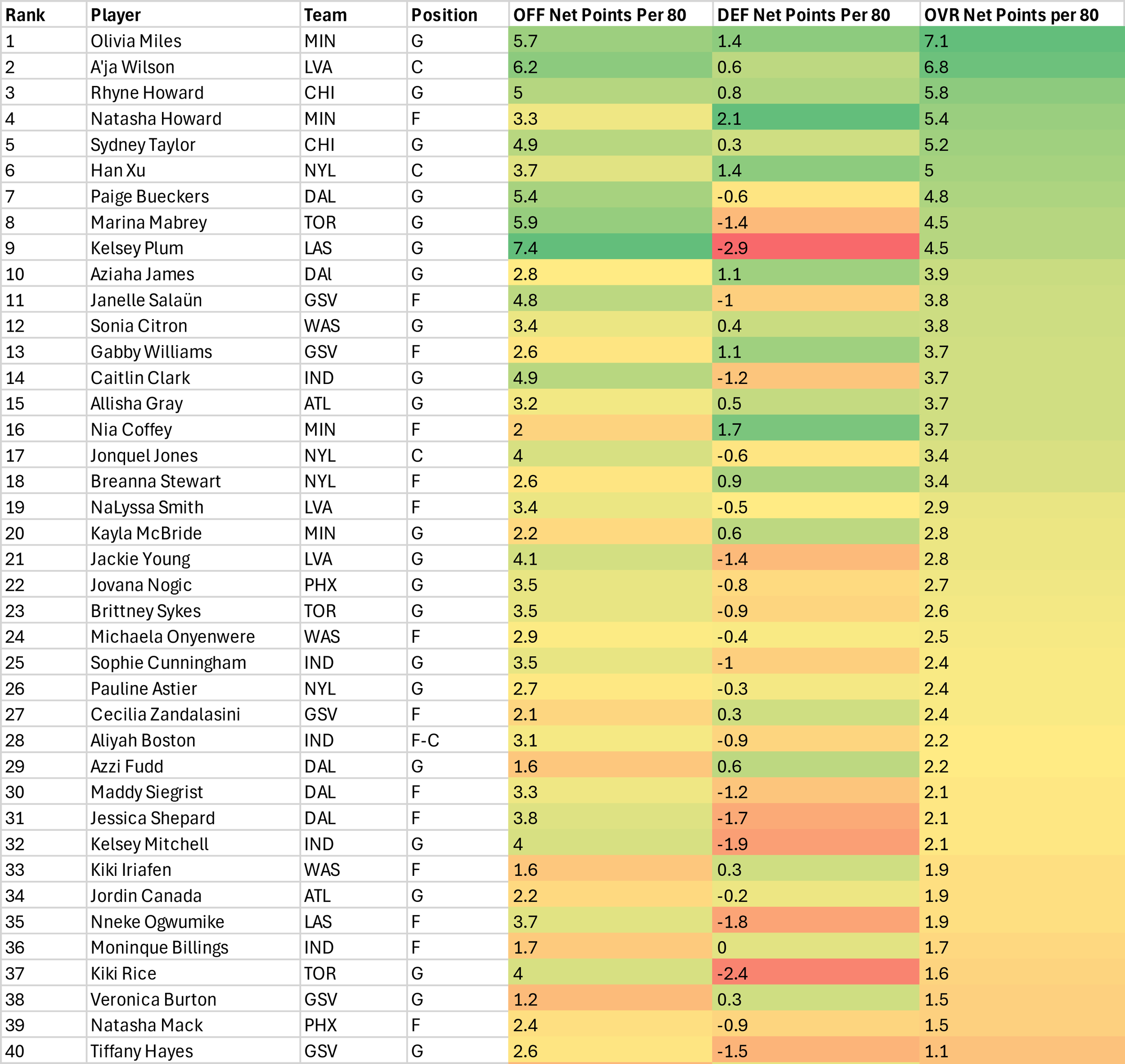
*Qualifying players needed to have played 221 minutes or more (the equivalent of 11+ minutes per game)
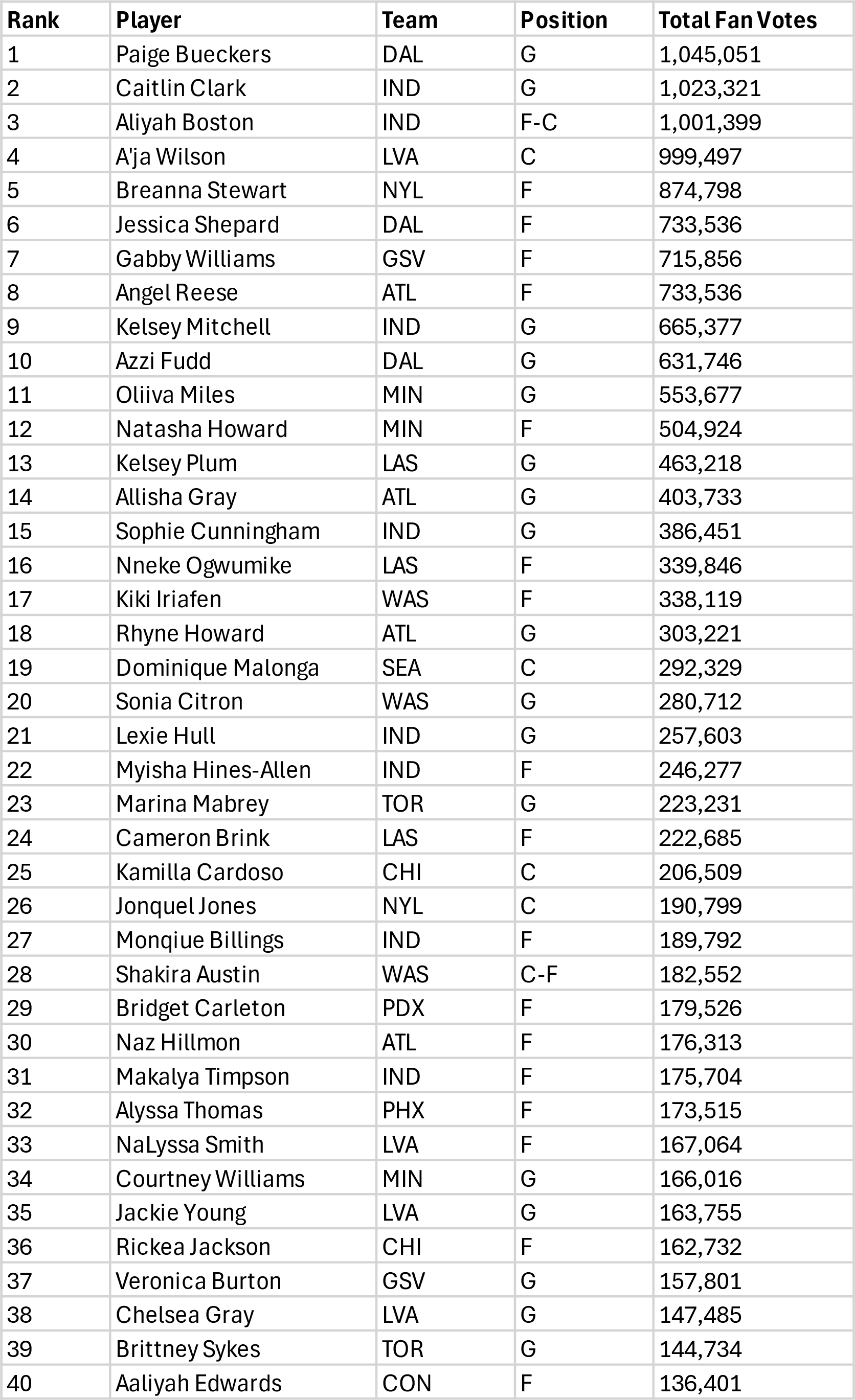
And who do the fans like? Here are the top 40 vote getters for the WNBA All-Star Game as released in their final tally on 07.02.26.
In a comparative analysis between rank by Net Points and by fans (those not in the top 40 of All-Star voting were assigned a rank of 41 for simplicity), what’s immediately apparent is some real-deal dissonance.
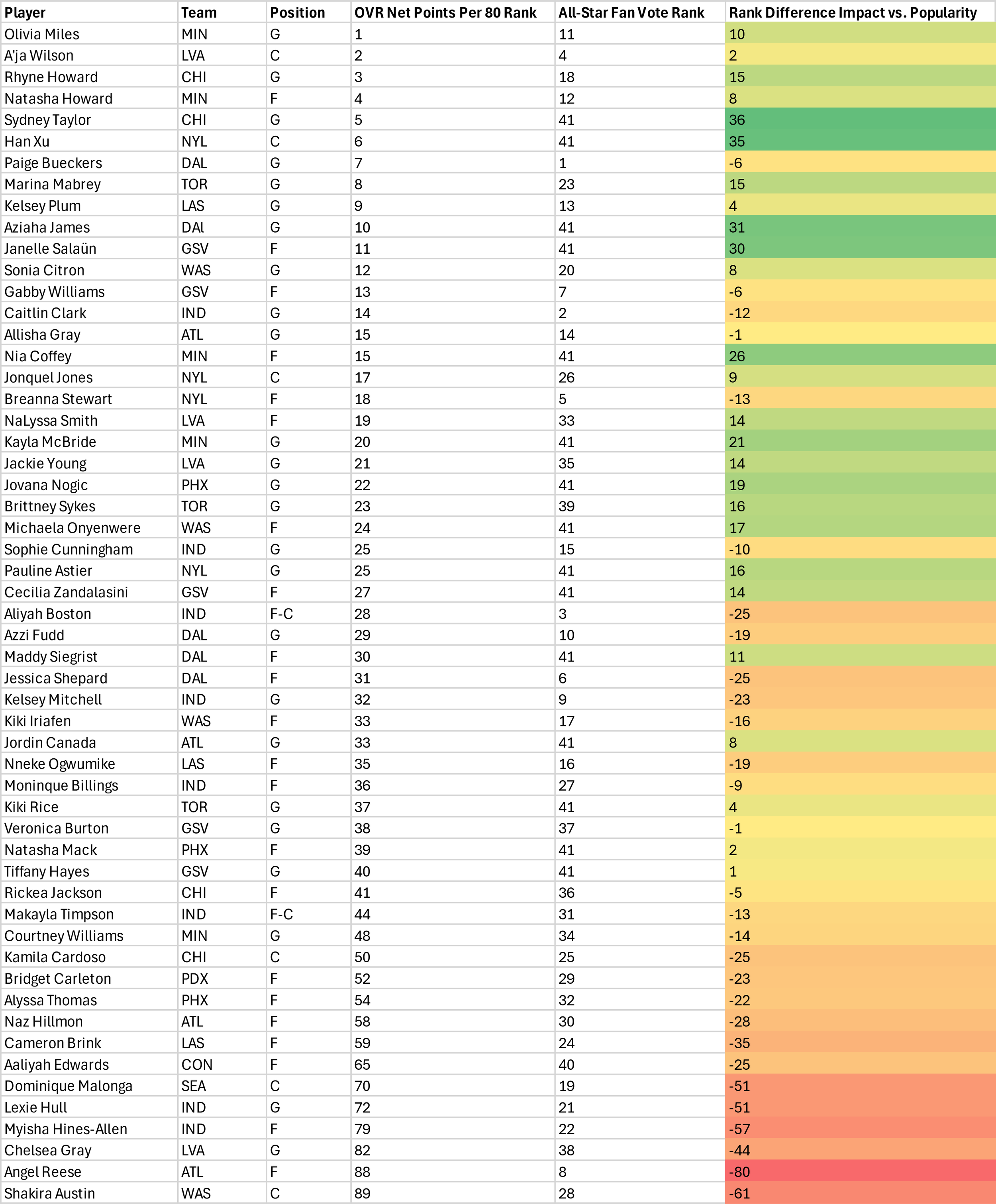
While the All-Star game is always a popularity contest to some degree, there’s a noteworthy divide between who fans call out as “stars” and who the analytics say have been the most winning players on a per possession basis. Only 26 of the top 40 Net Points players appeared in the top 40 for All-Star votes and only two players overlapped on the top 10 of each list, A’ja Wilson and Paige Bueckers.
There were some chasms: five names in the top 15 in Net Points didn’t even crack the top 40 of All-Star voting. These players have been among the league’s most effective contributors to winning but have been relegated to the fringes of the fan-o-sphere’s consciousness. Now to set the record straight, this is not saying the top Net Points performers are better than the fan favorites, but rather this gives insight as to who should probably be getting more flowers for consistent positive on-court impact. With that in mind, here are some observations on five of the most underrated players in the first half of the 2026 season.
Sydney Taylor, Guard, Chicago Sky
5th in Net Points (+4.9 OFF, +0.3 DEF, +5.2 OVR)
Taylor has defied the odds to average strong positive Net Points for a 6-13 Sky team, though she’s made a habit of proving people wrong. After four years of college ball at UMass, Taylor transferred to Louisville in her final year of eligibility, but her counting stats and efficiency went down, and she was left undrafted in 2024 and pivoted to playing overseas instead. Fast forward two years later and Taylor has turned a Sky training camp invite to a roster spot to a starting role, and just 17 games into her career, it’s easy to see why.
On a team headlined with savvy vets like Skylar Diggins and power players like Kamilla Cardoso, Taylor’s explosive speed unlocks Chicago’s transition game and adds a potent layer to their halfcourt sets. She’s their fastest end to end player that can turn defensive rebounds into transition opportunities and early offense as she flashes towards the rim or hits her teammates with pitch-aheads.
Despite her 5’9 frame, Taylor is a fearless driver, with the ability to use both hands and jump off either foot fluidly, and she leads all rookies with a blistering 70% on paint shots on good volume, ranking sixth in paint attempts at 7.5 per 40 minutes. She draws clean looks with her quick first step but also instinctually uses the rim for protection and craftily leverages her hangtime to adjust shot angles and time releases. And she’s not adverse to contact either, earning the third-most free throws (6.1) among rookies per 40 minutes and converting them at a high clip (87.5%).
Taylor is just as aggressive on the perimeter, leading all rookies in three-pointers per game (5.2) with a fast but smooth, no dip release. She loves to cash in from long distance above the break off the catch, but as she’s been given freer rein within the offense, she’s also publicized a lethal right-to-left hang crossover dribble to set up pull-up jumpers.
Taylor’s combination of speed, shooting, and unrelenting confidence gives her an ability to attack closeouts unlike any other player on the Sky, and even as an undrafted rookie, she has already established herself as the team’s most dynamic advantage creator on the perimeter. As Kamilla Cardoso’s continues her growth arc as a bully in the post, Taylor’s rapid ascension as a slasher and a scorer has given the Sky the outside-in changeup to put opponents on their heels.
Han Xu, Center, New York Liberty
6th in Net Points (+3.7 OFF, +1.4 DEF,+ 5.0 OVR)
Han Xu has had a circuitous path with the New York Liberty to say the least. A second-round draft pick in 2019, she was selected as a high upside but raw prospect from the Women’s CBA. She initially played a small bench role in 2019, then COVID hit. Then she came back in 2022 and 2023, again in a predominantly bench role, before returning back to the CBA. She has come back to the Liberty for her third stint in seven years, and while she’s still playing a reserve role, she’s beginning to emerge as the game-bending stretch five that was a squint of the imagination before.
At 6’11 with a 7’2 wingspan, Han can occupy massive amounts of valuable real estate on defense, and she’s often stationed near the short corners or at the nail where she’s only one step away from seriously challenging drives and shots in the paint. While Han is not a prolific shot blocker, she is patient and disciplined on defense, keeping her feet on the floor and her arms out wide or up high, weaponizing her length to bother and alter shots and minimizing fouls and opposing free throws. If Han is within an arm’s length of the basket, drivers tend to stop short and settle for tough floaters, mid-range shots, or kickouts to reset the offense, making her an excellent last line of defense against lineups that don’t have enough shooting to draw her out.
On the other side of the ball, Han has carved out a role as a matchup nightmare. She’s a cheat code in halfcourt offense—her size makes it so that almost all but the biggest, strongest centers can’t stop her if she establishes post position. Han doesn’t have a fancy toolkit down low, but her decisive drop steps and quick flick baby hooks allow her to score on mismatches quickly before the defense has a chance to react.
The most eye-watering aspect of Han’s game though is her 3-point prowess. She’s shooting a blistering 45.5% on three-pointers this season, good for fifth best in the league among qualified players. Her release is a quick flick, and combined with her height, is close to unblockable. Even when she’s stationed in a corner, the looming threat of her shot forces opposing bigs to play more conservative help and stray away from the basket, opening up driving lanes and giving frontcourt associates like Breanna Stewart and Jonquel Jones more room to operate inside.
Han’s frame also allows her to set formidable screens, and the Liberty like to flow her from screener into post-ups against switch-happy defenses. And for teams that deploy drop-heavy coverage, Han can comfortably run pick-and-pops and ghost screens, giving the second unit a bonafide counterpunch against these schemes.
Aziaha James, Guard, Dallas Wings
10th in Net Points, (+2.8 OFF, +1.1 DEF, +3.9 OVR)
Highly touted as a pure bucket-getter coming out of NC State, James was selected in the first round in 2025 as a talented but curious fit next to Dallas’ already heavy investment in the backcourt. Now with the latest addition of number one overall pick Azzi Fudd, James has essentially become the fourth guard in a star-studded guard rotation featuring Bueckers, Ogunbowale, and Fudd.
After an uneven rookie season that saw James struggle with the signature part of her game, bucket-getting, logging a below league average 46.2% true shooting, James has bounced back and become a sparkplug in the Wings surge towards playoff contention, though not in the way most would have assumed from her college profile.
In year two, James has become a little things queen, an espresso shot of hustle off the bench, providing plus rebounding and defense to stabilize three-guard lineups that the Wings often favor. She uses her elite hops to snatch rebounds that only forwards and centers have business getting, and she competes and consistently boxes out other guards with her improved strength. She’s become an elite rebounder for her size, top 3 in RB% among all guards.
And she’s become a solid point-of-attack defender that has the speed and length to pressure and keep pace with lead ballhandlers. James, along with Fudd, is often tasked with the tougher backcourt assignments so that Bueckers and Ogunbowale can conserve their energy for offense. James has top-notch reflexes and has excelled at poking the ball away from lackadaisical dribblers and deflecting less-than-perfect passes, leading the league in steal rate at 4.4%. The agility extends to her feet too, as she’s been particularly adept at sliding in front of the restricted area to cut off drivers, frustrating opponents and providing a surprising source of rim protection, and she also leads the league in charges drawn at nearly 2 per 40 minutes.
James’ energy and disruption on defense has translated to teamwide success. The Wings have been a middling defensive unit as a whole, but when James is on the court, the Wings average a 100.4 DefRTG, good for the second-best defense in league, only behind the Minnesota Lynx.
Ironically, the most inconsistent part of James’ game remains her scoring: her shot diet of midrange pull-ups and floaters and low percentage from behind the arc have held her back from becoming a two-way force. However, James continues to show she’s a tough shotmaker, particularly on the left side of the paint and midrange when she can plant and launch off two feet. She sports a league-leading rate of 1.6 AND-1s per 40 minutes, and if she gets one to drop, it’s a warning shot to opponents: long day ahead.
Janelle Salaün, Forward, Golden State Valkyries
11th in Net Points, (+4.8 OFF, -1.0 DEF, +3.8 OVR)
Another undrafted player, Janelle Salaün, is a young French basketball player that first experienced success at the French national, Italian national, and Euroleague levels. She joined the Valkyries in 2025 in their first year as an expansion team, and immediately carved out a starting role as a sharp-shooting forward and helped Golden State reach the playoffs in its inaugural season.
Now in her sophomore year, after the Valkyries retooled with big-name addition Gabby Williams, Salaün has shifted into a sixth woman role, and the downtick in minutes but uptick in usage has elevated her play and enabled the Valkyries to thrive in their famously deep rotations that emphasize “emptying the tank.”
While Salaün is playing fewer minutes per game this year (down from 27.0 to 22.6), she’s been given the green light to shoot even more. She’s actually increased her 3pt attempts from 4.8 to 6.4 and is the second in the league among all forwards in 3pt attempts per game, despite coming off the bench.
Even at such high volume, Salaün’s long distance accuracy at 37.5% clocks in well above league average. She is unfazed by hard closeouts and seems right at home with knocking down triples with a hand in her face. She also enables the Valkyries to snowball advantages that Veronica Burton, Gabby Williams, and others create on drive-and-kicks, as she easily counters scrambling defenders’ fly-by contests with a smooth pump fake, one dribble sidestep. And she does all of this with scalable range, shooting even better on deep threes from 25+ feet out (40% on 2.3 attempts per game).
The gravity from her shooting prowess has been a skeleton key for the Valkyries offense, and per the league official “gravity” measurement, Salaün has the second-strongest gravitational pull on the team after All-Star Gabby Williams. Her ability to pull defenders, even as an off-ball mover, has allowed the Valkyries to warp wider lanes for cutters and drivers.
Yet Salaün is no one-trick pony. She packs this perimeter skill in a legitimate 6’2 forward size and still has the post principles and face-up game to take advantage of smaller matchups. Even on a squad with a team-attack philosophy, her versatile scoring has made her reigning coach of the year Natalie Nakase’s go-to option for offensive baseline and sideline out-of-bounds plays with short shot clocks. Her finesse at her size, combined with her ability to dribble and shoot, make her the surest bet to capitalize on drives and catch-and-shoots when there is not enough time to run full concepts and secondary actions.
Few teams would trust a bench player to execute in these crucial situations, but for Salaün, there is no lesser bother than a hand in the face.
Nia Coffey, Forward, Minnesota Lynx
T-15th in Net Points (+2.0 OFF, +1.7 DEF, +3.7 OVR)
For the past decade, Coffey has been on a journey. The fifth overall pick in 2017, Coffey has had a muted career relative to expectations. She was traded twice and waived in the first five years of her career, and the last five have seen her bounce from team to team from one short-term contract to the next. Now with her fifth franchise, it feels like Coffey has finally found her perfect fit in Minnesota.
After superstar Napheesa Collier went down with a major ankle injury that would sideline her for several months, the Lynx had a vacuum at starting power forward, and Coffey stepped in. Since then, the Lynx have imposed their will as the league’s stingiest defense (97.4 DEFRTG) and racked up the league’s best record (15-4). While rookie phenom Olivia Miles and decorated veterans Natasha Howard, Kayla McBride, and Courtney Williams have been given much of the credit, Coffey has been the metronome keeping the defensive juggernaut in rhythm.
Coffey brings an edge of toughness and physicality to every lineup she is in, but her superpower is shot blocking, both on-ball and as a help defender. Her block rate of 5.1% is eight-best in the league, and she has an exceptional sense of timing and positioning. She perfectly juggles rim deterrence responsibilities with the coverage of her assignment and routinely smacks away at-rim attempts of overzealous drivers while maintaining the awareness and proximity to offer balanced closeouts on kickouts and ball reversals.
In addition to paint protection, Coffey’s active hands and 6’7 wingspan have made her highly disruptive in the passing lanes as an off-ball defender, so even though she doesn’t gamble for steals, she sits in the top 30 in steal rate. Her size, mobility, and defensive IQ, also give her the tools needed to be a highly switchable defender in the frontcourt. She has the strength to contend with true centers and power post players and ample length and agility to cover all but the speediest guards on the perimeter.
On offense, Coffey has settled into the lowest usage rate (12.4%) of her career since 2020, but she plays within herself, doesn’t force shots that aren’t clean looks, and keeps her shot selection simple: spot-up threes, catch and finishes at the rim, and occasional straight-line drives to punish smaller matchups. A whopping 98.9% of Coffey’s points have come from three-pointers, points in the paint, or free throws. The results have been stellar, she’s enjoying a career-best 62.1% true shooting, boosted by another career-best of 43.4% three-point shooting.
And while Coffey is not a primary playmaker, she has showed a particular poise and precision to her connective passing this year too. She’s reading and reacting to defenses better than ever, decisively whipping the ball out to shooters if she draws help, and flipping it inside to cutters from the low post or top of the key. And quietly, she’s doing this with elite efficiency, sporting a top 10 leaguewide assist to turnover ratio (2.9).
After shaking off the label as a star that didn’t blossom, Coffey has become the best role player on the league’s best team, and the scary part for the rest of the league: Collier is still waiting in the wings.
What Now
After examining the disparity between on-court impact and fan perception, what can be taken away? Upon closer look at the most underrated players, are they “hidden stars” or beneficiaries of ideal roles and lineup compositions that amplify their strengths and mitigate their weaknesses?
Their circumstances may enable them to thrive, but when these players are on the court, they are undeniable contributors to their teams’ brands of winning basketball. They don’t shoulder the default weight of expectations like marquee stars, but they offer signature skills and counterpunches that expand win conditions and bolster team identity. And if further development happens, particularly for the rookie (Sydney Taylor) and sophomores (Aziaha James, Janelle Salaün) then stardom could be in their future.
The W is stacked with big names and living legends, but come September when the title chase ramps into full gear, these underrated few could tip the scales for basketball immortality.
Note: all league-wide stat rankings are among qualifying players that played 221 minutes or more.
Most stats pulled from stats.wnba.com
Certain advanced stats pulled from basketball-reference.com